Ludwig van Beethoven - Overture to Fidelio opera, Op. 72
Elżbieta Sikora - Concerto for Flute and Orchestra (world premiere)
Antonín Dvořák - Symphony No. 9 Op. 95 From the New World
Approximate duration of the concert: 115 minutes (including a 30-minute intermission)
Important information: Before the concert, we invite you to a recital held in the Level 4 Gallery between 6:15 pm and 6:45 pm. During the event, a historic piano from the pre-war Szczecin Konzerthaus – once located on the site of today’s Philharmonic – will be featured. Admission is free and available exclusively to holders of tickets for the symphonic concert on April 24. We look forward to welcoming you!
Each of these works was created at a moment of transition-when something ends, but it's unclear what will come next. The old world still casts its shadow, while the new one only begins to take shape. This concert is about such a moment: not about stability, but about movement-between eras, aesthetics, and places.
Beethoven wrote Fidelio at the intersection of two worlds -both aesthetically and historically. On the one hand, it follows operatic convention; on the other, it is a drama of freedom in the context of political oppression. Leonora, the main character, rescues her husband from prison by disguising herself as a boy -but that's just the outer plot. It's a transition story at its core: from darkness to light, from silence to action. The overture Beethoven ultimately chose is shorter and more functional than its earlier versions. It contains dramatic and heroic themes yet remains within a clear, classical form. The composer doesn't abandon old rules, but he already begins to bend them, trying to say more than tradition allows. It is music that still knows the old order, but already thinks in new ways.
Elżbieta Sikora has long built her music on the border between worlds: classical and experimental, form and sound. Her Concerto for Flute and Orchestra, the world premiere of which will take place during a concert at the Szczecin Philharmonic, fits into this trend -a piece in which a familiar instrument speaks the language of the present. It's not about shock but seeking a new space for an old voice. The flute, guided by Ana de la Vega, an Australian who has taken the international classical music scene by storm, becomes a guide through this unfamiliar terrain.
I composed this work with the Belarusian flautist Maria Kalesnikova in mind, who was imprisoned in Belarus. On the very day I placed the final double bar at the end of the score, Maria was released. An extraordinary coincidence…
In the concerto I use the sonorities of three flutes – standard, piccolo, and alto flute – in order to expand the sound space of the main instrument of this piece.
The opening four solo C-sharp notes are like a Morse signal sent into space, or like knocking on a door. They will reappear several times, transposed to F-sharp and returning to C-sharp. The flute, like a captive bird, tries to rise as high as possible, only to disappear in the final crescendo of the double basses and timpani – a signal of doors slamming shut.
In the middle of the second movement, which begins with a reflective, oscillating motif, the alto flute appears with its melancholic contemplation. This movement also ends with a crescendo of low sounds.
A carefree, self-confident rhythmic motif – a promise of freedom – opens the third movement. Here the piccolo flute appears, tracing the wild meanders of another bird’s flight, this time one that longs to fly even farther and higher. At any cost. The standard flute returns in an aleatoric, virtuosic cadenza, exploring the wide range of the instrument’s timbre. This time, the final flute note is accompanied by a diminuendo of the low sounds, which fade away, defeated.
In both the solo and orchestral parts I used a technique dear to me – controlled aleatoricism – which is not only a reference to one of Witold Lutosławski’s compositional methods, but also introduces an element of freedom, without which one cannot live.
Elżbieta Sikora
And then – the New World. Dvořák's title became a symbol, but the work itself is neither American nor Czech – it is in between. Composed in 1893 in New York City, it carries the full weight of homesickness. Dvořák listened to African-American and Native-American melodies, but he filtered them through his ear rather than quoting them. He created music from them that still moves listeners today.
This evening is not about what endures but about what changes. About the tension between the known and the unknown. About old forms and new meanings. And about the fact that music, though rooted, always moves forward.
Allegro con fuoco from Dvořák's Symphony No. 9 performed by the Vienna Philharmonic conducted by Gustavo Dudamel:
Elżbieta Sikora's Concerto for Flute and Orchestra – the work was commissioned by Württembergische Philharmonie Reutlingen, Malmö Symphony Orchestra, Opéra Orchestre national Montpellier Occitanie, the National
Centre of Culture of Poland and National Philharmonic Society of Lithuania.
Supporting Partners
DETAILS
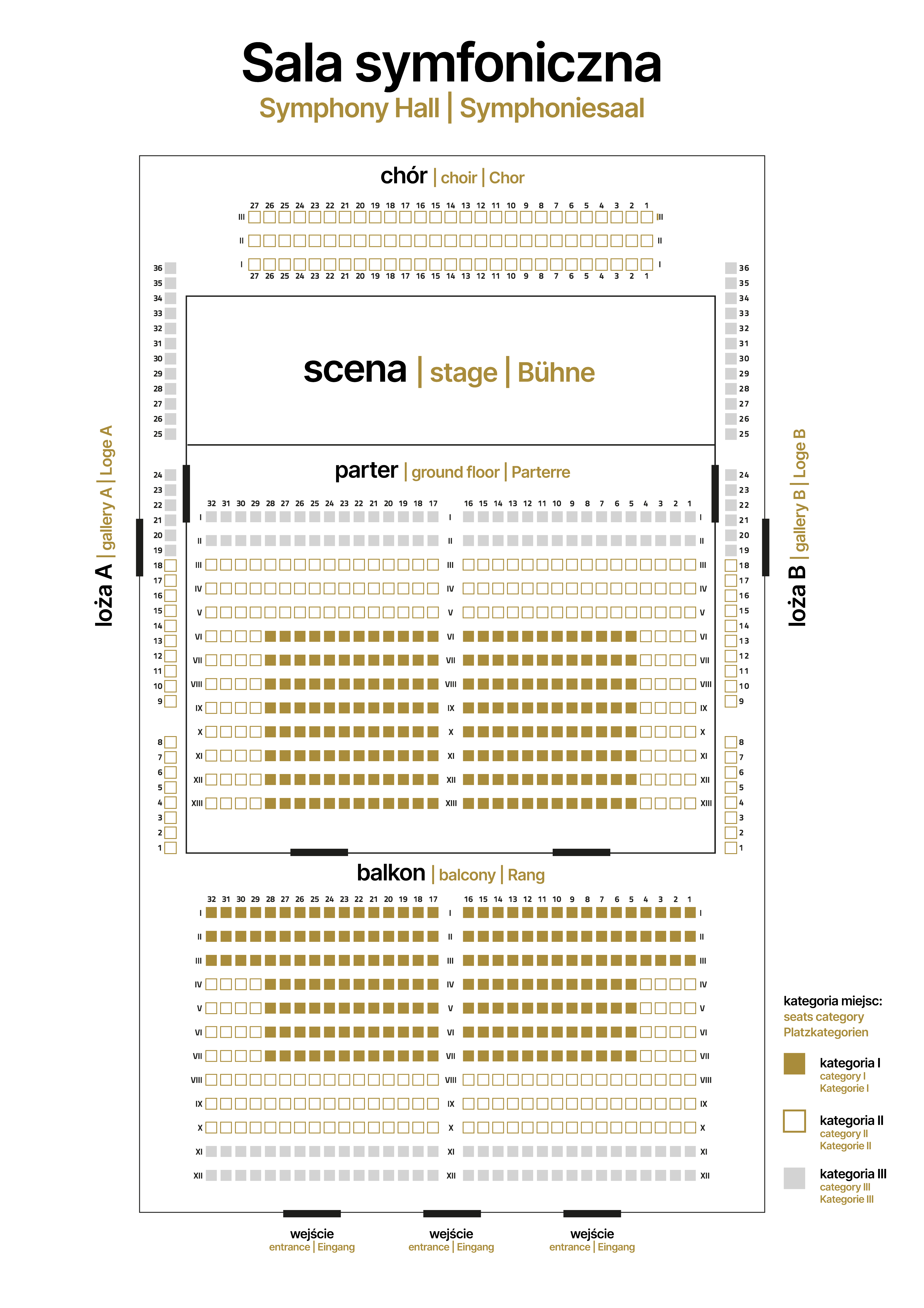
Something in between 24-04-2026 19:00
Symphony HallFilharmonia im. Mieczysława Karłowicza w Szczecinie
ul. Małopolska 48
70-515 Szczecin